
Welcome to the Beam documentation. Beam adds real-time audio and video calls, screen sharing and browser-to-browser file transfer to Laravel applications — the way Laravel Echo added real-time events: PHP authorises, the browser joins with one line, and the hard parts are handled once, for everyone.
Introduction
A call is two browsers sending media straight to each other. What Laravel has to do is small and precise: decide who may call whom, tell the callee, carry a few messages while the browsers find each other, and mint the credentials a relay needs. Beam does exactly that, and nothing else. It stores nothing, renders nothing, and never sees a frame of video.
Two things this page says before anything else. First, TURN costs money: roughly one call in five cannot connect without a relay, and a relay bills by the gigabyte — Beam supports four providers and says so on the first page rather than the last. Second, Beam is headless by design: it ships the class that makes a call work and the events that tell you what is happening; the screen is yours, with a working one copied in by beam:install --views when you want a start.
Two things it does
A call. One person rings another, or people join a room.
$call = Beam::call($ticket->customer)->video()->about("Ticket #{$ticket->id}")->ring();

return view('calls.show', ['token' => $call->token]);const call = await Beam.join(token);
call.attach({ local: '#me', remote: '#them' });The customer's open tab rings through Laravel Broadcasting; a closed one rings through Web Push. When they answer, the two browsers connect directly — or through the relay you configured — and CallEnded fires on your server with the duration when it is over.
A file. One person sends another a file, straight from browser to browser. It needs no call: with none in progress, Beam sets up a data-only connection, and the other side sees an offer to accept or decline.
const transfer = Beam.send(file).to(userId);
transfer.on('progress', ({ percent }) => bar.style.width = percent + '%');
await transfer.start();Beam.onFileOffered(async (offer) => {
const blob = await offer.accept(); // resolves once every byte is in and the hashes agree
saveAs(blob, offer.name);
});The bytes never touch your server or your storage; FileTransferred tells you it happened. File Transfer has the whole of it.
Where it fits
| Situation | What you build with |
|---|---|
| A support agent calls a customer from a ticket, shares a screen, sends a fix | Support Desk — calls, screen share, a file inside the call |
| A doctor and a patient meet at an appointment link | Telehealth — rooms with an expiry |
| A signed contract, a scan, a build — sent to one person, stored nowhere | Secure Documents — files with no call at all |
| A buyer reaches a seller without either sharing a phone number | Marketplace — calls gated by a listing |
| A technician shows head office a boiler through a phone camera | Field Inspection — the rear camera, a relay on cellular |
What it looks like
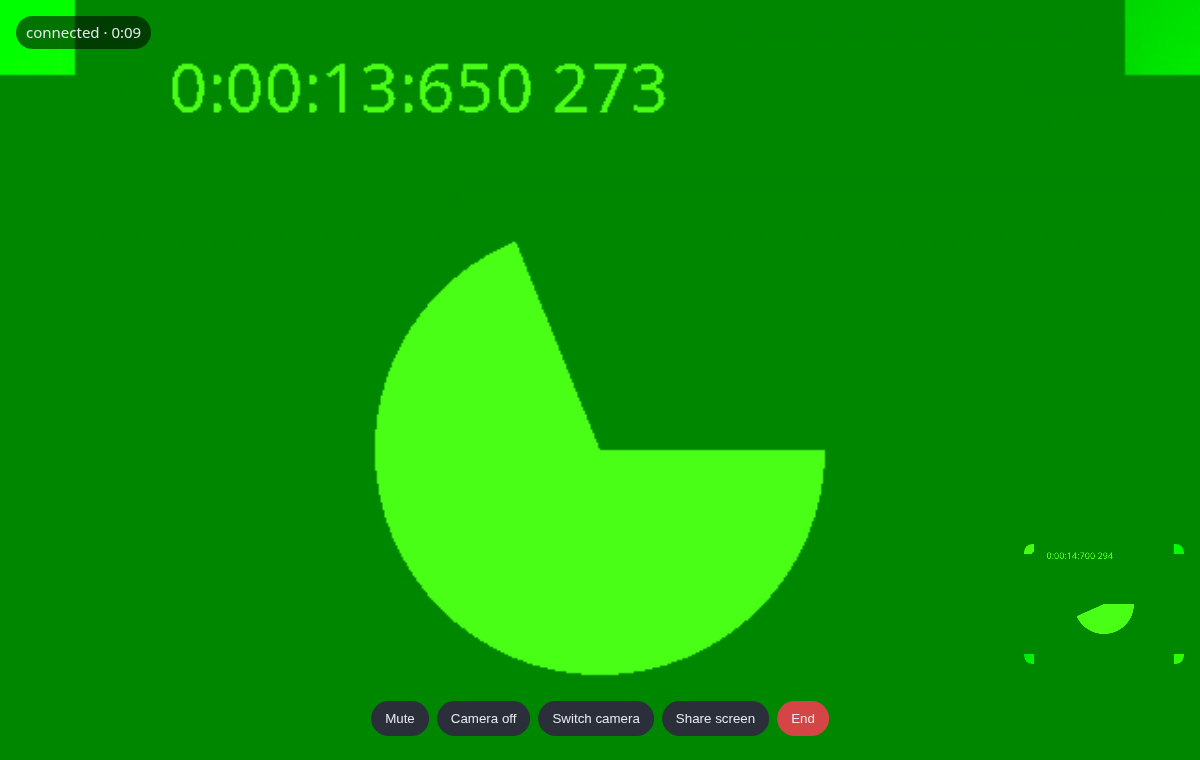
The copied call screen, connected, in the browser rig — two fake cameras, a real Reverb server, real WebRTC:
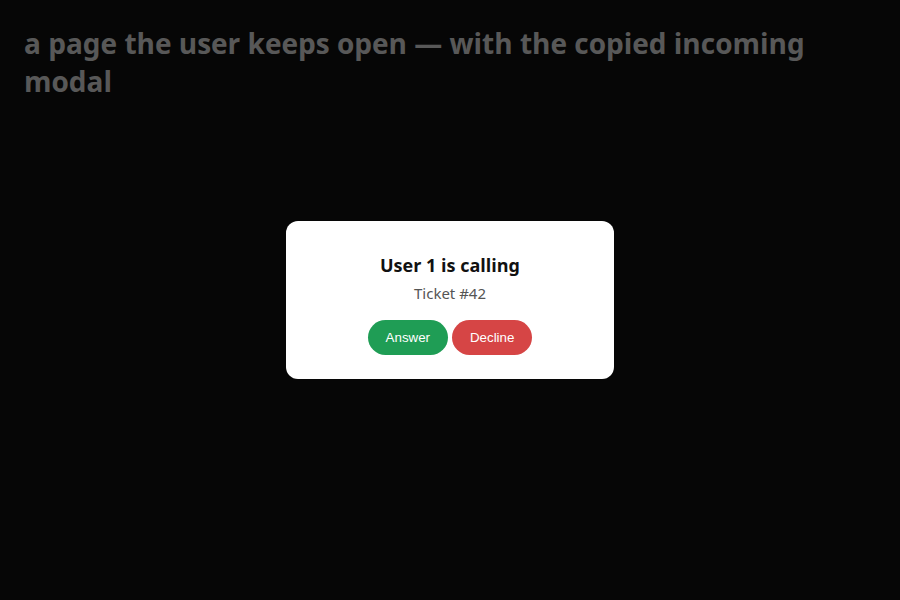
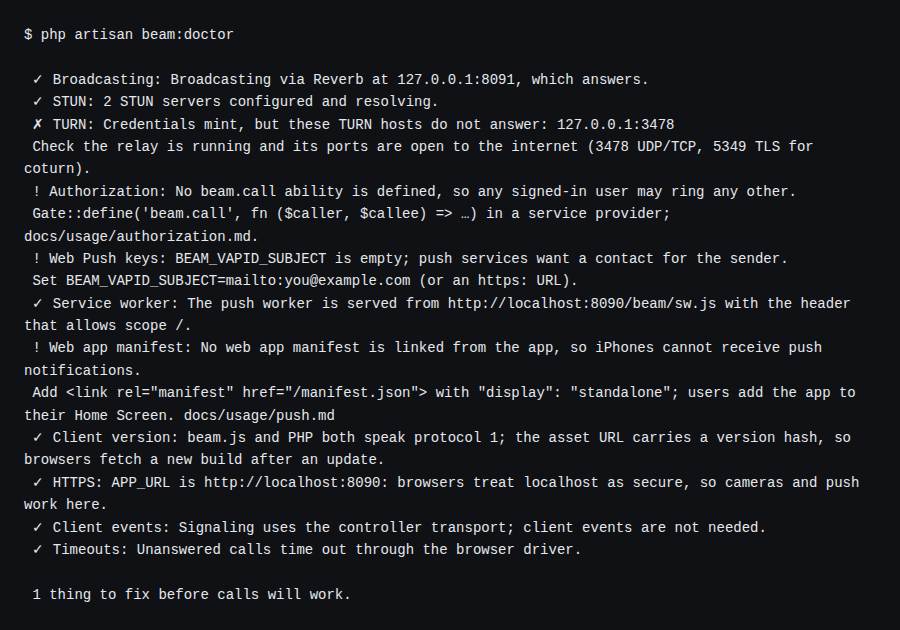
The incoming-call modal on a page the callee keeps open, and beam:doctor on a fresh install:
Every image in these docs is captured by the test rig from the real thing, never mocked up.
Features
- Calls and rooms:
Beam::call($user)rings a specific person;Beam::room($name)creates a stable address people join — a consultation link, a support session. - One token, one line: PHP hands the browser a signed token carrying the call, the role, the channel and the ICE servers. The page contains no configuration.
- Screen sharing and controls: mute, camera, switch camera, share screen, choose the speaker — each a method on the call, each an event when it changes.
- File transfer, peer to peer — with or without a call:
Beam.send(file).to(userId)moves a file browser to browser over a data channel, with progress, resume after a drop, and a SHA-256 check at the end. No call in progress? Beam opens a data-only connection for it. Nothing touches your server or storage. - Four TURN drivers: coturn, Cloudflare, Twilio and Metered — per-participant, time-limited credentials minted on the server, never a secret in JavaScript.
- Rings a closed tab: Web Push built in, with a service worker Beam serves; or route the notification to FCM and APNs through your own channels.
- Resilient by default: perfect negotiation, ICE restarts on a network drop, a heartbeat that lets the server end a call whose browsers both died, duration measured on the server.
- Five frontends, one class: Blade with no build step (
@beamAssets), jQuery ($.beam), Livewire, Inertia + Vue (useBeam) and Inertia + React (useBeam). - Testable:
Beam::fake()withassertRang(), and a two-browser Playwright rig in the repository that proves real calls in Chromium, WebKit and Firefox. - Laravel Boost ready: a shipped guideline and skill, so an AI assistant writes Beam's way — see Laravel Boost.
beam:doctor: twelve checks — Broadcasting, the cache, STUN, TURN, gates, VAPID keys, the service worker, the manifest, the client version, HTTPS, client events, the queue — each line saying what to do next.
Getting Started
Support My Work
If you find Beam helpful and would like to support my work, you can buy me a coffee. Your support will help keep this project alive and thriving. It's a small token of appreciation that goes a long way.

License
Beam is open-sourced software licensed under the MIT License (MIT). Please see License File for more information.
Made with ❤️ from Pakistan