
 Artisan Commands
Three commands: one to install, one to diagnose, one that the scheduler timeout driver runs for you.
beam:install
php artisan beam:install
php artisan beam:install --views
php artisan beam:install --migrations
php artisan beam:install --force
Publishes config/beam.php; writes a VAPID key pair to .env once (--force regenerates it — every existing device subscription stops working, so do that on purpose); warns when Broadcasting is not configured.
It does not publish the migration, because it does not need to: Beam loads beam_push_subscriptions from the package, so php artisan migrate creates the table with nothing copied into your project. --migrations publishes it for an application that wants to edit it — and the copy keeps the package's filename on purpose, so that it shadows the original rather than becoming a second migration for the same table.
--views copies a working call screen (resources/views/beam/call.blade.php) and an incoming-call modal (resources/views/beam/incoming.blade.php), plus resources/js/Pages/Beam/Call.vue or Call.jsx when package.json has Vue or React, and prints the routes to wire them. Existing files are left alone without --force.
Publishing on its own
Everything beam:install does is also a tag, for a deploy that would rather be explicit:
php artisan vendor:publish --tag=beam-config       # config/beam.php
php artisan vendor:publish --tag=beam-lang         # lang/vendor/beam/en/beam.php — what the ring says
php artisan vendor:publish --tag=beam-views        # the call screen and the incoming modal
php artisan vendor:publish --tag=beam-migrations   # only to edit the table; see above
about
Beam adds a section to Laravel's own php artisan about, which is the quickest way to see what an application is set to do — and the first thing worth pasting into an issue:
  Beam ..........................................................................
  Client ................................................................ 8f2c1a
  Push store ................................................. not configured
  Registry cache ............................................................ redis
  Signaling ............................................................ controller
  Timeouts .................................................................. queue
  TURN driver .............................................................. coturn
  Version ................................................................. v1.0.0
beam:doctor is the other half of that pair: about says what is configured, the doctor says whether it works.
beam:doctor
php artisan beam:doctor ✓ Broadcasting: Broadcasting via Reverb at 127.0.0.1:8080, which answers.
✓ Cache: Live calls are held in the [redis] cache, shared across servers. Keep cache:clear out of your deploy: it ends every call in progress.
✓ STUN: 2 STUN servers configured and resolving.
! TURN: No TURN relay is configured: calls behind symmetric NAT and most mobile carriers — roughly one in five — will not connect.
→ Set BEAM_TURN to coturn, cloudflare, twilio or metered and fill in its keys. TURN costs bandwidth; docs/guide/turn.md.
! Authorization: No beam.call ability is defined, so any signed-in user may ring any other.
→ Gate::define('beam.call', fn ($caller, $callee) => …) in a service provider; docs/usage/authorization.md.
✓ Web Push keys: VAPID keys are present and well-formed; subject mailto:you@example.com.
✓ Service worker: The push worker is served from https://app.test/beam/sw.js with the header that allows scope /.
✓ Web app manifest: A web app manifest with display: standalone is linked; iPhones can be rung once the app is on the Home Screen (outside the EU).
✓ Client version: beam.js and PHP both speak protocol 1; the asset URL carries a version hash, so browsers fetch a new build after an update.
✓ HTTPS: APP_URL is https (app.test); cameras, screens and push are allowed.
✓ Client events: Signaling uses the controller transport; client events are not needed.
✓ Timeouts: Unanswered calls time out through the redis queue; keep a worker running.
Nothing is blocking a call.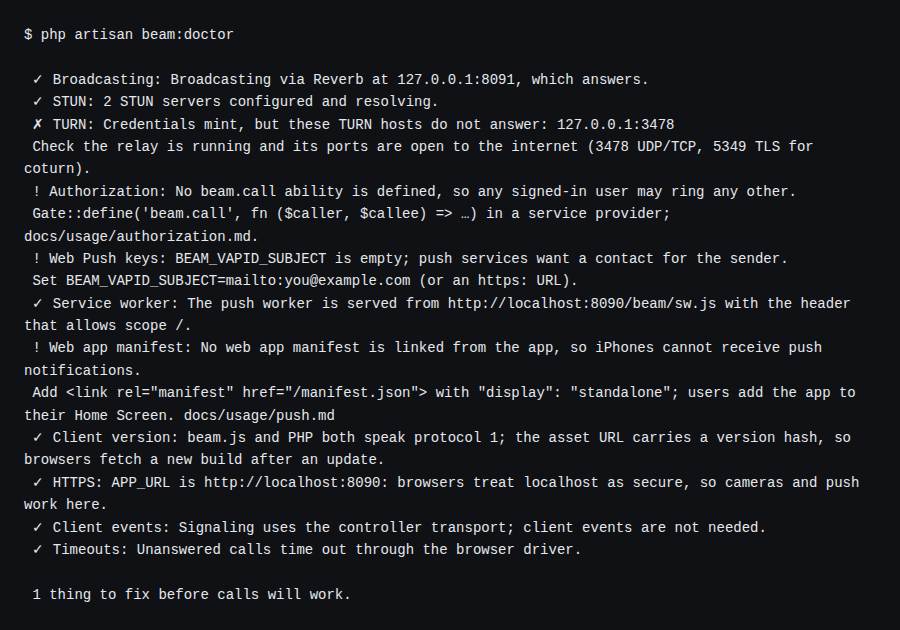
Twelve checks, one line each: fine, `!` worth knowing, a call cannot work until it is fixed — and the exit code is 1 when anything is ``, so it can gate a deploy. Each non-green line is followed by what to do.
Two of the checks — the service worker and the web app manifest — fetch the app's own APP_URL. Run the doctor from a terminal, or from a queued job; called from inside a web request served by php artisan serve, those two can time out waiting for a worker that is busy serving the request itself. Production servers do not have that problem.
An application can add its own line:
use RealRashid\Beam\Commands\DoctorCommand;

DoctorCommand::add(RecordingBucketCheck::class);   // implements RealRashid\Beam\Support\Doctor\Check
beam:sweep
php artisan beam:sweepDeclines rings nobody answered and ends calls nobody is in any more. With call.timeout.driver set to scheduler, Beam registers it on the scheduler every minute and you never run it by hand; with the queue or browser driver it is still there for a one-off tidy.
Made with ❤️ from Pakistan