
 Push Notifications
An open tab rings through Broadcasting. A closed one rings through a notification: Web Push out of the box, or your own channels — FCM, APNs, SMS — through Laravel's Notification system. Beam decides which to use by whether a tab is listening.
Web Push, built in
Three pieces, all shipped: a VAPID key pair (beam:install writes it to .env), a service worker served at /beam/sw.js with the header that lets it control scope /, and a subscription store (push.store: the beam_push_subscriptions table, or the cache).
Subscribe each device once, from a click — browsers refuse a permission prompt that nobody asked for:
enableButton.onclick = async () => {
    await Beam.push.subscribe();     // registers the worker, asks permission, stores the subscription
};

await Beam.push.status();            // 'granted' | 'denied' | 'default' | 'unsupported'
await Beam.push.unsubscribe();
From then on, ring() sends IncomingCallNotification to the callee unless one of their tabs is known to be listening: a page with Beam.onIncoming() posts a presence heartbeat every 30 seconds, and a user seen within 45 is rung by Broadcasting alone. The notification shows "Name is calling" with the about line, and two actions:
- Answer — an open tab of the app answers in place through
Beam.onIncoming(); otherwise the worker opens the app at$call->link()(your route namedbeam.join, or the app root) with?beam=<token>&answer=1, andawait Beam.answerFromNotification()on that page joins. - Decline — the worker posts the decline straight to your server;
CallDeclinedfires. It proves itself with the token the push carried rather than with a session and a CSRF token, because a service worker has neither: the endpoint (POST {prefix}/calls/{id}/decline-by-token) is outside the session middleware and accepts nothing else. A tap that loses the race — answered on the laptop, or already timed out — is a quiet 204.
// On the page beam.join points at
const call = await Beam.answerFromNotification();   // null when the page was opened normally
if (call) call.attach({ local: '#me', remote: '#them' });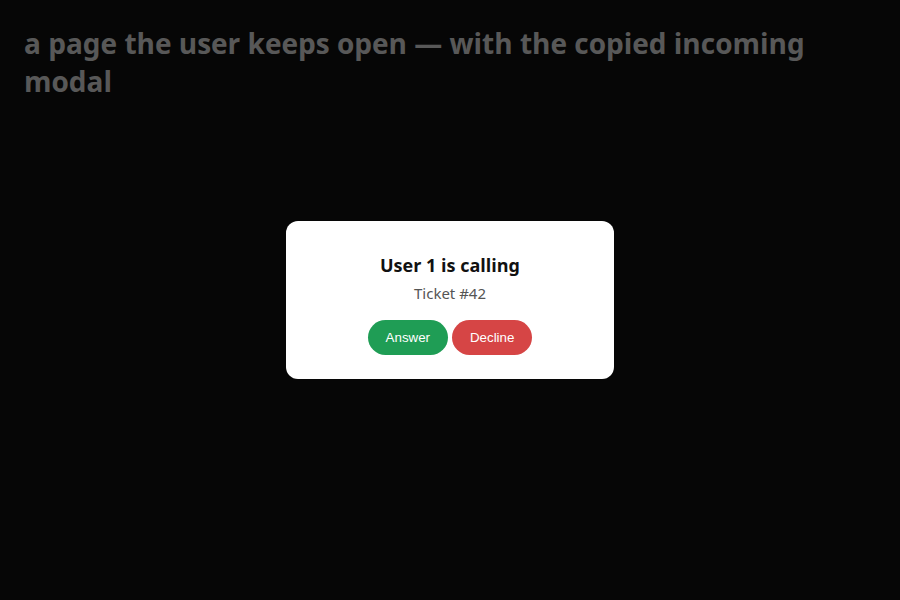
Phones
- Android (Chrome, Firefox, Samsung Internet): works in the browser as-is.
- iPhone and iPad: Web Push exists only for a web app added to the Home Screen, on iOS 16.4 or later. That needs a web app manifest with
"display": "standalone"linked from your pages;beam:doctorchecks for one once VAPID keys are set.Beam.push.status()reportsunsupportedin a Safari tab and works once installed;platform.supportsPush()says the same, so you can show an "Add to Home Screen" hint instead of a broken button. In the EU, iOS opens installed web apps in Safari and there is no push at all — a native app is the only way to ring an EU iPhone that is not on the page. - Desktop Safari 16 and later takes a plain page.
Your own channels
IncomingCallNotification is an ordinary Notification. Route it wherever the user already gets notifications:
class User extends Authenticatable
{
    use Notifiable;

    public function routeNotificationForBeam(): array
    {
        return ['webpush', 'fcm'];   // Beam's Web Push channel, plus your own
    }
}
toArray() carries callId, from, about and media for any channel; toWebPush() adds the callee's token, the link and the decline URL. A native app that receives it can open the app's call page with ?beam=<token>&answer=1 and let answerFromNotification() do the rest.
What is stored
Only the subscription: the push endpoint and its two keys, per user, with the user agent and a timestamp. A device is identified by the SHA-256 of its endpoint — the URL itself is too long for any database to index — so re-subscribing the same browser replaces its row rather than adding one. PushSubscribed fires when one is stored. A subscription that the push service reports gone (410) is removed on the next send.
What it says, and in which language
Every string on that notification comes from a published language file, so changing the wording — or the language — does not mean replacing the notification:
php artisan vendor:publish --tag=beam-lang// lang/vendor/beam/en/beam.php
'notification' => [
'calling' => ':name is calling',
'video' => 'Video call',
'audio' => 'Voice call',
'answer' => 'Answer',
'decline' => 'Decline',
],Add lang/vendor/beam/ur/beam.php and a user whose locale is ur is rung in Urdu. The about line is your own text and is shown as you wrote it.
Ringing a phone whose owner has a tab open somewhere
By default a tab seen in the last 45 seconds suppresses the push — the thinking being that Broadcasting already reached them, and two rings for one call is worse than one. An idle tab on a locked work laptop is not the same as the person being there, so it is a setting rather than a rule:
'push' => ['suppress_when_online' => false], // ring the phone as well, alwaysIf your application already has a service worker
Registering a worker at a scope replaces whatever was registered there, so Beam.push.subscribe() — which takes scope / by default — would evict a PWA's own worker. Two ways round it, and the first is better:
// your-worker.js, at the top: Beam's handlers become part of your worker
importScripts('/beam/sw.js');
Beam's worker only adds push and notificationclick listeners, so importing it composes with yours and you never call subscribe()'s registration. If you would rather keep them apart, give Beam a narrower scope — Beam.push accepts one — and accept that notifications only ring from pages under it:
Beam.configure({ pushScope: '/calls/' }); // before Beam.push.subscribe()A subscription is tied to the VAPID key it was made with: rotate the keys and every existing device would be refused with a 403 for ever, so subscribe() notices the mismatch, drops the old subscription and makes a new one.
The endpoint arrives from the browser and your server posts to it on every incoming call, so Beam checks where it points: https only, and never your own network — a private or reserved address, localhost, or a single-label host is refused with a validation error. push.endpoints in the config narrows it further to a list of services you name; empty, the default, accepts any public one. Configuration has the list to paste in if you want the tighter posture.
When the push is sent, and how long it may take
ring() sends the push inline, so it is on its way before the caller's request returns — a ring that waits for a queue worker is a ring that can arrive after the caller has given up. Two keys bound and change that:
'push' => [
    'timeout' => 4,                                  // seconds per device before giving up
    'queue'   => env('BEAM_PUSH_QUEUE', false),      // true: hand it to the queue, return at once
],
timeout matters more than it looks: without it, the underlying HTTP client has none, and a push service that stops answering would hold the request that placed the call until PHP gave up on it. With queue on, ring() pays nothing and delivery is as prompt as your worker — a good trade when a worker is always running, and a bad one when it is not.
Made with ❤️ from Pakistan